
Business office moves
How the whole move runs: downtime, sealed boxes for the sensitive files, and the seven things we need to quote it.
Guides / Office e-waste
An office move is the one day every retired computer, dead printer and mystery cable surfaces at once. Two things about that pile are worth knowing before the truck is booked: recycling it is free for a small business under a national scheme, and the data sitting on it is your job before any of it leaves the building. This page covers both, and every figure on it is sourced at the bottom.
Disposing of office waste is often necessary in business office moves.
Relocating to another office can be exciting and stressful at the same time. It entails lots of processes that can be disruptive to your business operations. As much as possible, you want the transition to be organised and smooth. But with sensible planning, efficient communication, and careful property auditing, it can be done without a hitch.
Whether your office takes the full hands-on approach or hires the best removalists in Newcastle, know that some tasks can only be done by outsourcing the job. One of those is the removal of e-wastes and other commercial junks.
Old towers under desks, monitors that came off the wall two fit-outs ago, the printer that jams. It accumulates because on a normal working day there is never a reason to deal with it. A move is the reason: everything gets picked up once anyway, so the sorting is finally free.
The scale of what offices and households quietly store is real. Australia generates about 500,000 tonnes of e-waste a year according to the federal government's National Waste Report, and in 2022 only about half of it was recycled, with just 35% of the valuable materials recovered. One more number from the same report is worth a pause: 535 facilities around the country accept e-waste, but only 20 actually reprocess it. Dropping something off and it being recycled are not automatically the same thing, which is why the scheme and the certificate later on this page matter.
None of that is a guilt trip. It is the case for spending one afternoon of the move doing this properly, because the proper channel costs a small office nothing.
Both panels are drawn to scale from the National Waste Report figures. The method and the source are at the bottom of the page.
Tonnes of e-waste Australia generates each year
Kilograms of e-waste per person per year
Drawn to scale: each bar is its value divided by the largest value in its panel. All four figures come from the National Waste Report, reported by ABC News, February 2025. Method and sources.
E-waste includes any discarded electronics or electrical equipment that uses electric energy to work. When they have served their purpose and are no longer functioning, this equipment requires a particular way of disposal.
E-waste contains dangerous chemicals, such as cadmium and lead, that can leech into the environment. Improper disposal of e-waste can severely harm the environment and cause significant health risks.
E-waste problem continues to worsen, as the world experiences a rapid development in technology. Australia is among the countries with the highest consumers of technology. Every year, Australians buy three million televisions and four million computers. Consequently, the country is also among the biggest contributors to the global e-waste pandemic.
These seven figures are the ones published with this guide in April 2020, and several of them are dated in the text by the year they measure. The current national totals are the two panels above.
As you plan on moving to another office, you might want to consider an excellent scheme that can help you manage e-waste, particularly computers. The National Television and Computer Recycling Scheme can provide you with free service of collecting and recycling the computers that your office no longer uses or need.
The National Television and Computer Recycling Scheme is a federal program, funded by the companies that import and make the equipment, and it is free for households and small businesses. It covers exactly the things an office move surfaces: TVs, computers, laptops, printers, computer parts and peripherals. You do not pay a commercial e-waste contractor to take a dozen towers and monitors away. You take them to a scheme drop-off point, or have someone do that run for you, and the scheme handles the rest.
It is not a token effort, either. The scheme collects around 70,000 tonnes a year, its collection target rises to 80% of what enters the market by 2026-27, and 90% of the weight collected must be re-used or turned into new products. That last rule is what separates a scheme drop-off from a skip bin with better signage.
Drop-off points change, so we won't print one here and let it go stale. The government's own answer for finding a current site is RecyclingNearYou or the Recycle Mate app: put in your postcode and the item, and it lists the accredited points near you.
City of Newcastle runs a free e-waste drop-off: small electricals and electronics, up to 10 items per visit, for Newcastle LGA residents with proof of address. That makes it the answer for the odd item going home with a staff member, not for a whole office clear-out in one run, and it does not take whitegoods. The staffroom fridge goes through Summerhill's Sort & Save scrap metal line instead.
Outside the LGA, in Lake Macquarie, Maitland or Port Stephens, your own council runs its equivalent. RecyclingNearYou will point you at it.
The NSW government strongly advocates the recycling of e-waste. The National Television and Computer Recycling Scheme (NTCRS) is an industry-funded system of collecting and recycling e-waste. This system facilitates the process of collection and recycling for householders and small business owners.
A fundamental part of office moving is the decluttering and removal of items that are not needed anymore. As e-waste can pose health and environmental hazards if not disposed of responsibly.
Here are some ways you can safely manage and discard your electronic office equipment:
Gather all your office equipment for disposal; group them according to size and kind (monitors, keyboards, printers, cartridges, etc.) to make things organised.
Large electronic equipment like photocopiers and printers can be dropped off at a recycling facility near you. Also, there are recycling companies that offer to come and collect your electronic office equipment for a reasonable fee.
There is a national program designed to take and recycle used printer cartridges. You might consider dropping yours in their facility.
There are also recycling programs that will help take care of your other office electronics. They also give information about e-waste recycling as well as assist you with other recycling options.
You can also take advantage of the local government recycling programs that can help you with your e-waste disposal.
If your equipment is still in decent condition and good working order, and you are planning on upgrading your office equipment, consider donating them. Some schools and charity institutions will readily take them. Passing them on to friends or family who might find them useful, or taking them to second-hand stores, are also good options.
Some electronic companies can take your old equipment for refurbishing purposes. Check with the manufacturing company of your equipment to determine if they accept used ones for refurbishing.
You can store the equipment out of the weather until they are ready for collection.
Here is the part most small offices have never had to think about. Old computers, servers and backup drives hold years of client details, financials, invoices and email. Many office photocopiers and multifunction printers keep copies of what they scanned on an internal drive. The free recycling scheme is built to recover materials, and dropping a machine off does not automatically deal with what is stored on it. That job happens before the equipment leaves your hands, and it is straightforward once it is on the list.
Computers and laptops, the server, loose external and backup drives, and the photocopier. If it stored files, scans or email at any point, it goes on the list, working or not.
A proper software wipe to the recognised standard for anything being recycled or passed on, or physical destruction for drives you'd rather not think about again. The three levels are defined below.
A certified recycler will hand you a Certificate of Data Destruction alongside the recycling certificate. File it. It is the difference between "we think it was wiped" and being able to show it was.
Some office equipment stores data related to your client details or information about your business. The information can be sensitive or confidential, and you don’t want the data from ending up in the wrong hands. Before taking your office equipment for recycling or giving them away as a donation, it is a good practice to delete all data from your device.
Another important reason for removing all files and data is to avoid a possible breach of security and privacy. Also, electronic media like flash drives and hard drives might be used for unlawful activities.
If you hand the data job to a professional, these are the words on the quote. They come from the two standards that govern this work, and knowing them is how you tell a certified operator from a bloke with a van.
Probably not yet, and we would rather tell you that straight than imply otherwise. Here is where the Privacy Act actually reaches, per the federal privacy regulator, as it stands in 2026.
| Your situation | Where you stand |
|---|---|
| Small business, under $3 million turnover, none of the categories below | Generally outside the Privacy Act. The small business exemption still stands. |
| Real estate, legal, conveyancing or accounting practice | Covered for that client data since 1 July 2026 under the extended AML/CTF rules, whatever your turnover. |
| Health service provider, a business trading in personal information, or a Commonwealth contractor | Covered regardless of size, and always has been. |
| Turnover over $3 million | Covered. Serious or repeated breaches carry penalties up to $50 million, three times the benefit gained, or 30% of adjusted turnover, whichever is highest. |
Scroll sideways for the full table on a phone.
So why bother if you are in the first row? Two reasons that are not scare tactics. The practical one: an unwiped drive with client details and old invoices on it is a bad week waiting to happen whether or not a law applies, and your clients will not parse the exemption. The forward-looking one: every reform proposal for years has moved toward narrowing that exemption, not widening it, and the July 2026 change to professional services is exactly that direction in action. Building the wipe-and-certificate habit now, while the pile is on a trolley anyway, costs almost nothing.
Minimising e-waste production can be equally important as the proper disposal of e-waste. Not only will this practice help prevent further accumulation of e-waste in the country, but it also helps conserve resources used to produce electronic equipment. Here are some tips to minimise your office e-waste:
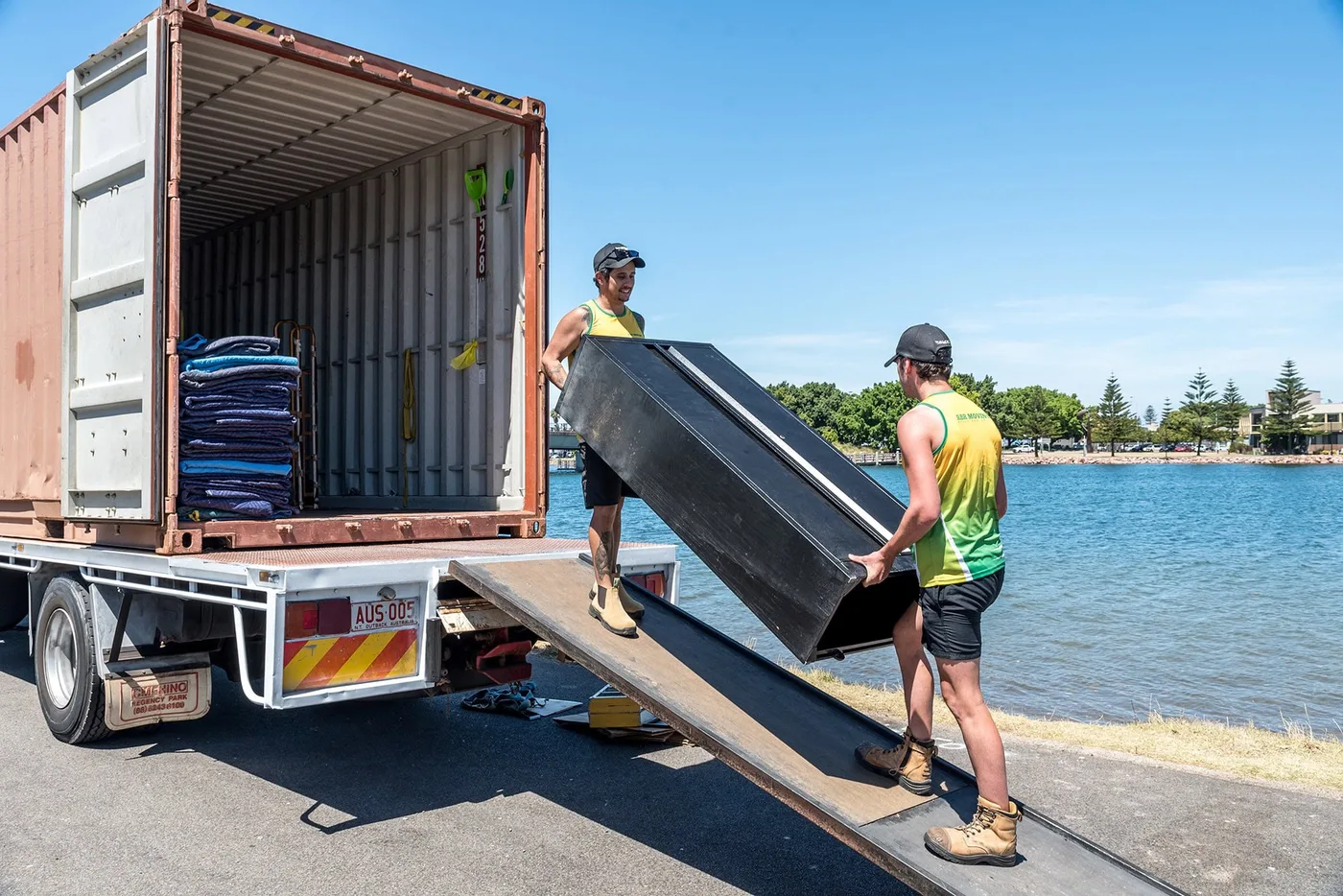
Straight answer on our part in this: we are removalists. We move the business that is continuing, and on an office move that means the desks, files, people's working machines and the server that is coming with you, planned around your trading hours. The e-waste run to a scheme drop-off is a separate errand, and honestly one your own team or IT support can do in a ute once the pile is sorted and wiped.
The reason to sort before we visit is money, plainly. An office move is quoted on what is moving. Every dead monitor that leaves via the free scheme instead of the truck is a thing nobody wraps, carries or pays hours on, and the quote comes back leaner because the list is. How our quoting works is on the pricing page.
On the day itself, the same two rules from our office move guide hold: anything data-bearing that is coming with you travels in sealed, labelled boxes, loaded last and unloaded first, and anything you are not taking is wiped before it leaves the building. Afterwards, our valet service can clean the old premises and take the packing waste away so you hand the keys back to a tidy floor.
Our trucks move what your business is keeping; e-waste disposal is not a removals service and we would rather say so than quietly charge hours for carting it. The good news is you do not need us for it: the national scheme takes office computers, screens and printers free, and once the pile is sorted it is one ute run to a drop-off point. Do that run before moving day and the move itself gets smaller and cheaper.
Yes. The National Television and Computer Recycling Scheme is free for households and small businesses, and covers TVs, computers, laptops, printers, computer parts and peripherals. It is funded by the companies that import and make the equipment. It does not cover whitegoods or office furniture; the staffroom fridge and the desks are a different conversation.
Look it up on RecyclingNearYou or the Recycle Mate app rather than trusting a printed address; collection points change. If you are in the Newcastle LGA, City of Newcastle also runs a free e-waste stream, up to 10 items per visit for residents with proof of address, which suits the odd item rather than a full office clear-out.
Two things before it goes anywhere. First, most office copiers are leased, so check the lease; it usually goes back to the supplier, not to recycling. Second, many copiers and multifunction printers keep copies of scanned documents on an internal drive, so ask the supplier in writing what happens to that drive at end of lease. If you own the machine outright, treat its drive like any computer's: wipe or destroy, then recycle.
No. Deleted files are routinely recoverable with ordinary tools. The recognised benchmark is NIST 800-88, which defines three levels: Clear, a basic overwrite; Purge, an advanced overwrite or cryptographic erase that defeats lab-grade recovery; and Destroy, physical destruction. For most small office gear a Purge-level wipe with certified software is the practical standard, and a recycler certified to AS/NZS 5377 will do it and give you a certificate saying so.
For most small businesses under $3 million turnover, not currently; the Privacy Act's small business exemption still stands. Real estate, legal, conveyancing and accounting practices are covered for that client data since July 2026 regardless of turnover, and health providers, businesses trading in personal information and Commonwealth contractors have always been covered. We would still wipe everything regardless: the reform direction is toward more coverage, and your clients' details on a drive you cannot account for is a problem no exemption fixes.
The two stat panels are drawn to scale: each bar is its value divided by the largest value in its panel (657,000 tonnes in the first, 20 kg in the second), and the "up about 30%" label is the published projection, not our arithmetic. Nothing on this page is estimated by us, and where the law is unsettled we have said so rather than rounded up.
Reporting the National Waste Report figures: 500,000 tonnes a year, 20 kg per Australian against a 7 kg global average, roughly half recycled in 2022 with 35% of materials recovered, the projected rise to 657,000 tonnes by 2030, and the 535-facilities-but-20-reprocessors gap. Also the source for the scheme's 70,000 tonnes collected a year.
The federal environment department's own page: the scheme is free for households and small businesses and covers TVs, computers, printers, computer parts and peripherals, with RecyclingNearYou and Recycle Mate named as the locators for current drop-off points.
The regulatory basis (Recycling and Waste Reduction Act 2020 and the 2021 product stewardship rules), the collection target rising to 80% by 2026-27, and the requirement that 90% of collected weight be re-used or remanufactured.
The NIST 800-88 sanitisation levels (Clear, Purge, Destroy) and the assessment that Purge-level wiping with certified software is the practical standard for most small office equipment.
The Australian standard for collection, storage, transport and treatment of end-of-life electrical equipment, and the practice of certified recyclers issuing a Certificate of Data Destruction alongside a Certificate of Recycling. The standard text itself is sold by Standards Australia, so we cite a page describing it.
The federal privacy regulator on the $3 million small business exemption, the categories covered regardless of size, the AML/CTF extension to designated services from 1 July 2026, and the penalty ceiling for serious or repeated breaches by covered entities. Current as at August 2026; the exemption's scope is under ongoing reform, which is why the page above hedges the way it does.
The council's free e-waste stream (10 items per visit, Newcastle LGA residents, proof of address, no whitegoods) and the scrap metal line whitegoods go through instead. Offices outside the LGA use their own council's equivalent.
How the whole move runs: downtime, sealed boxes for the sensitive files, and the seven things we need to quote it.
Cleaning and packing-waste removal at the old premises, so the landlord gets a tidy handback.
Hourly rates, the depot to depot rule and how a fixed price quote works. A smaller list is a smaller number.
Planning to make a business office move soon? Let us help make it easy for you so you can focus more on your business operations. When it comes to reliable and efficient moving solutions in the Newcastle area, Best Removalists Newcastle is your best choice! Let us know how we can best assist you with your corporate relocation by contacting us.
Sorting the office for a move and want the keep pile quoted? Start an office move brief or call Owen on 02 4058 5810.
Call Owen for a free quote and onsite in-home assessment of your home or office move in Newcastle.
Prefer a detailed fixed-price quote? Fill in the request a quote form and we can often quote without a site visit.